


Game Production
What Are Idle Games? Definition and Examples
Idle games, also called incremental games, thrive on waiting and automation. We explain the genre, its mechanics, and present well-known examples.
Alexander Frey, Nikola Merkas

Game Production
Amazon's Lumberyard engine is based on CryEngine and is now open source as the Open 3D Engine. We explain its history, features, and technology.
In our series on the best-known game engines, this time we look at an unusual candidate: the Lumberyard engine by Amazon. It is closely related to the CryEngine, deeply integrated into Amazon's cloud services, and lives on today under a new name. This article gives an overview of its history, technology, and features.
Lumberyard is a cross-platform game engine by Amazon that first appeared in 2016. It is based on the CryEngine and stands out above all for its integration of Amazon Web Services (AWS) and the Twitch services. Via AWS, developers can build their project on Amazon servers and host it for players. Thanks to the Twitch integration, viewers of a stream can be drawn directly into the gameplay. Among the best-known titles associated with the engine are the space simulation Star Citizen and the 2021 MMORPG New World by Amazon.
 A robot at the edge of a valley, from the in-game graphics of the Lumberyard demo title 'Lost'
Amazon released Lumberyard on February 9, 2016. From 2018, the software ran in a beta phase, with updates appearing at irregular intervals up to version Beta 1.28. With Beta 1.3, support for VR arrived. In 2017, the source code was published on GitHub under a source-available agreement.
The most important turning point came in 2021: since then, the engine no longer bears the name Amazon Lumberyard, but Open 3D Engine, or O3DE for short. It has since been developed openly by the Open 3D Foundation, a project under the umbrella of the Linux Foundation. A once-proprietary in-house engine has thus become a genuine open-source project.
The engine is developed in C++ and Lua. Scripting is done via a FlowGraph system. Its structure is deliberately modular: developers can freely extend the engine via components, for example with entity behavior, UI systems, or engine subsystems. Assets are organized in so-called slices, a tiered prefab system that can be applied to any kind of level structure. Changes at higher levels automatically affect all slices below them. Graphics are handled by the Atom Renderer as an overarching sub-engine. The editor itself strongly resembles Unity or the Unreal Engine in its structure.
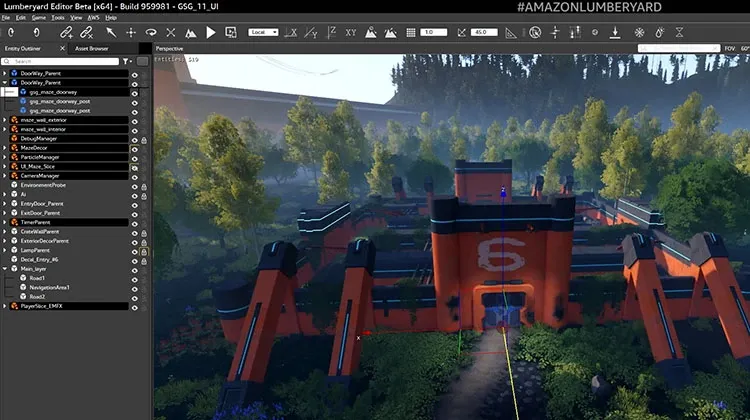 A screenshot of the Lumberyard interface while working on a project
Lumberyard, or O3DE, is a modular, easily extensible engine that can now be used freely on an open-source basis. For a long time, the close ties to Amazon's services were a point of criticism, and changes to individual components can unintentionally affect other subsystems. As an open-source project, however, the engine has experienced a second wind. Which engine ultimately suits a project depends heavily on the plan. At Studio Merkas, we mainly rely on Unity and Unreal, but we always choose the tool that fits the idea at hand. Feel free to get in touch with us if you have questions. For how other engines are structured, see our articles on the CryEngine and Source Engine.

Ready to get started?
We appreciate your interest in working with us. Whether you have an idea, a proposal, a question, or need assistance in another area, we’ll get back to you quickly—within 24 hours.